

Toll Free:
877.456.EFSI (3374)
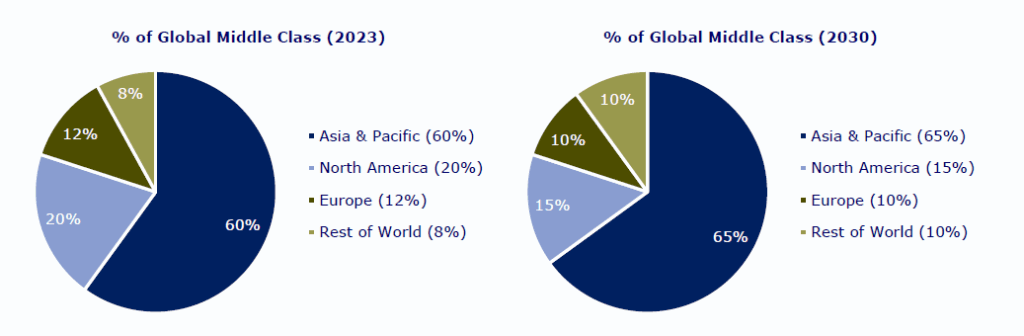
The Asia and the Pacific region (“APAC”) is home to 60% of the World’s population with 4.3 billion people. The Organization for Economic Co-operation and Development (the “OECD”) expects a dramatic increase in the Asian middle class as a share of global middle-class consumption in the coming future. Consumers ordinarily exhibit a growing propensity to borrow when they move into the middle class as they expect wages and salaries to grow. With this expectation comes the confidence of being able to repay debt and consequently a willingness to borrow. The vast majority of growth is expected to take place in Asia with other regions’ proportions reducing significantly.
Source: OCED
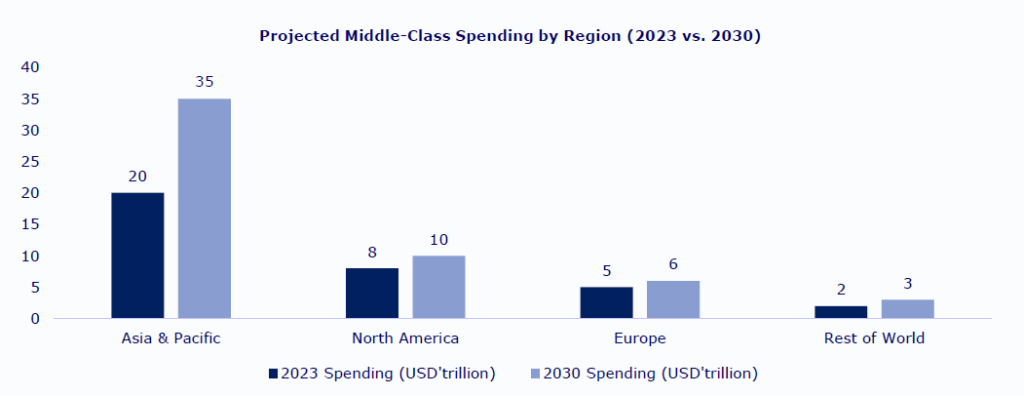
The OECD projects that 65% of the global middle class are expected to live in Asia by 2030, representing 3.5 billion people. Similarly, spending by the middle class from Asia has grown significantly. Asia has already become the largest continent for middle-class spending since 2015 and will keep its leading place through 2030. By 2030, Asia will account for over half of global middle-class spending, and such expenditure is expected to exceed US$35 billion.
Projected Middle-Class Spending by Region (2023 vs. 2030)
Significant Headroom Remains for Credit Penetration for Asian Consumers and SMEs
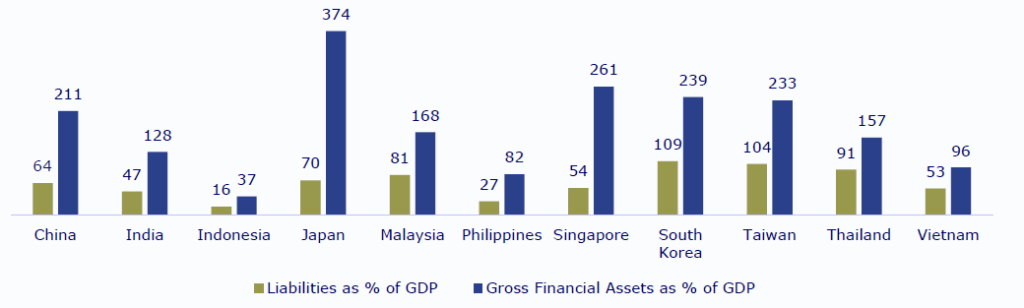
Domestic saving rates in developing Asian countries have been generally high in the past and are expected to remain relatively stable. Some higher income countries in Asia have reported higher household debt-to-GDP ratios. However, when considered together with high savings rates, the net leverage ratio in Asia remains considerably lower than in Western countries. Due to higher savings rates in Asia, Asian households are financially healthier and have significant headroom to use more credit in financing consumption. According to Allianz Global Wealth Report 2024, Asian household financial assets far exceed their household liabilities.
Asian Household Assets and Liability ratios, 2023 in %
Source: Allianz Global Wealth Report 2024
Consumer credit has only recently been introduced and accepted in much of Asia, and while in its early stages, is anticipated to expand rapidly in the coming years, supported by personal income growth, greater offering of financing products, policy stimulus and improving credit infrastructure. Overall, the Asian countries on average are still under-leveraged compared to the Western economies. An important factor to note is that this lower level of leverage is largely based on mortgages in Asia with relatively low loan-to-value ratios.

Source: IMF
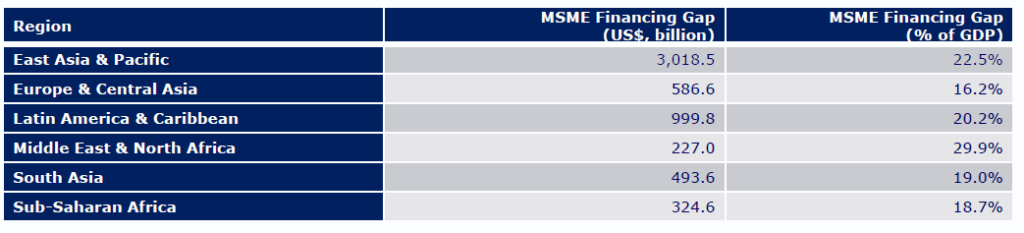
A similar picture emerges when studying data on SME financing gap in Asia. The World Bank data shows that the financing gap of MSMEs in East Asia & Pacific region is estimated to be significantly higher than other higher-income regions. As SME production will be required to expand rapidly in order to support increasing domestic consumption, demand for financing is predicted to grow in absolute and relative terms.
Source: IFC, MSME Finance Gap Report March 2025
Asian private credit presents significant growth potential arising from the imbalance between the growing demand of credit from issuers serving the rising Asian middle class and the shrinking supply of credit available from global banks due to changing regulations. The expanding middle class and widening SME finance gap create a fertile environment for consumer and SME lending making Asia an attractive landscape for private credit investments.
**********
Gregory Park is the Managing Director and Fund Head of Lending Ark.